Water Softener
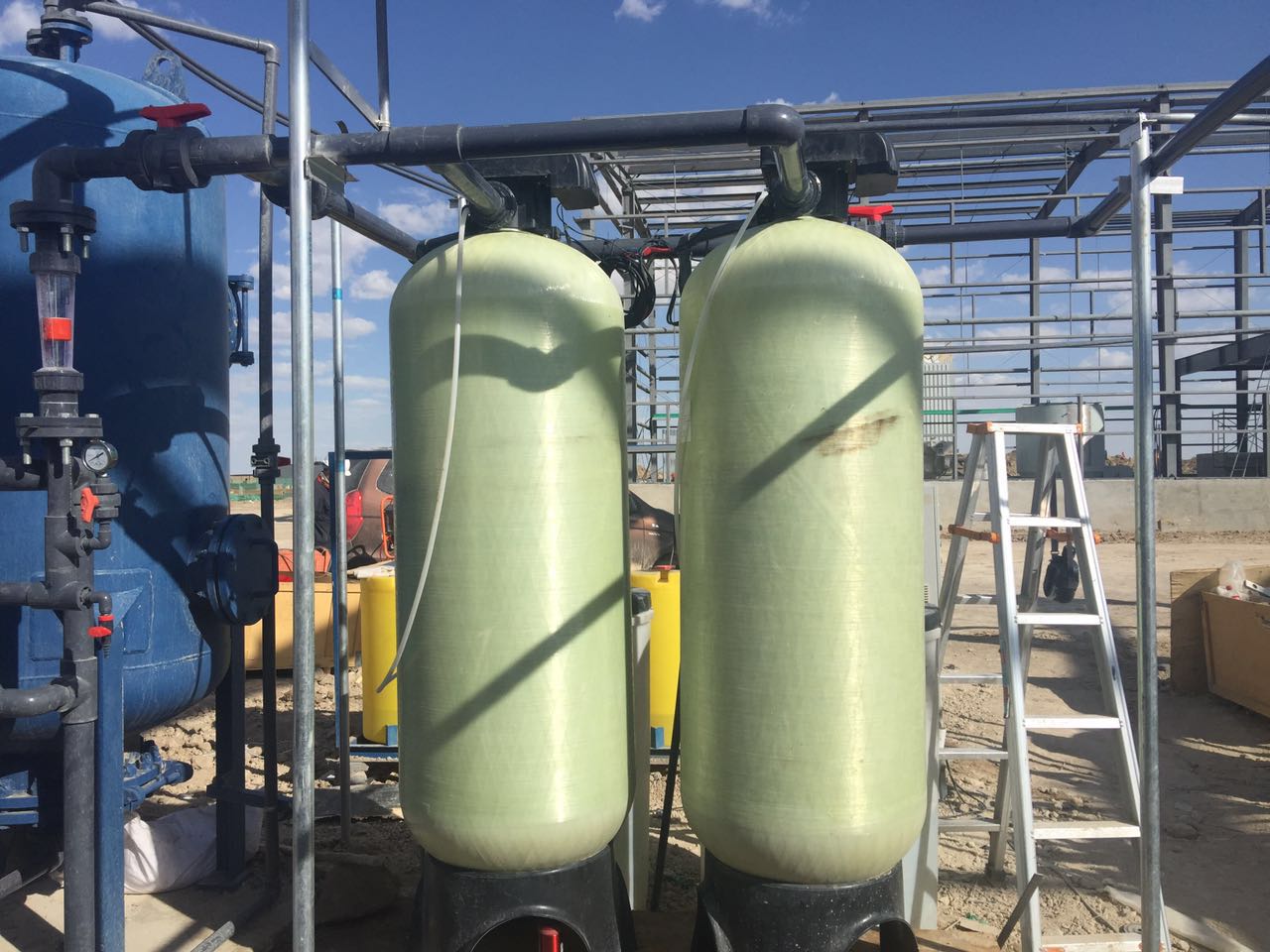
Mit Water fabricates industrial water softening systems using sodium-form strong acid cation (SAC) ion exchange resin for removal of calcium and magnesium hardness from water. Hard water causes scale formation in boilers, cooling towers, heat exchangers and reverse osmosis membranes, reducing thermal efficiency and increasing maintenance costs.
Working Principle
Hard water passes through a pressure vessel filled with SAC resin beads. Calcium and magnesium ions in the water exchange with sodium ions on the resin surface, softening the water. When the resin becomes saturated, a brine solution (NaCl) is introduced to regenerate the resin by displacing calcium and magnesium, restoring the sodium form. Regeneration is controlled automatically by a multi-port control valve.
System Configuration
Our water softeners are available as single-tank (intermittent flow) or twin-tank (continuous flow) configurations. Each system includes FRP or carbon steel pressure vessels, SAC ion exchange resin, a brine tank, automatic control valve, flow meter and interconnecting piping. The unit is pre-assembled on a skid and tested before shipment.
Water softeners are widely used to prevent scale formation:
- Boiler feed water pre-treatment for power plants and industrial boilers
- Cooling tower make-up water treatment
- Reverse osmosis pre-treatment to protect membranes from scaling
- Food and beverage processing water conditioning
- Laundry and textile processing water softening
- Hotel and commercial building water supply
- Car wash and industrial parts washing systems
Technical Parameters
| Flow Rate | 0.5 to 100 m3/h per unit |
| Resin Type | Gel-type strong acid cation (SAC), sodium form |
| Vessel Material | FRP or epoxy-lined carbon steel |
| Hardness Removal | Below 5 mg/L as CaCO3 (treated water) |
| Regeneration | Sodium chloride brine, timer or flow-initiated |
| Control Valve | Automatic multi-port valve |
| Configuration | Simplex (intermittent), duplex (continuous), triplex |
| Power Supply | 220V / 50Hz / 1-phase |