Ozone Systems
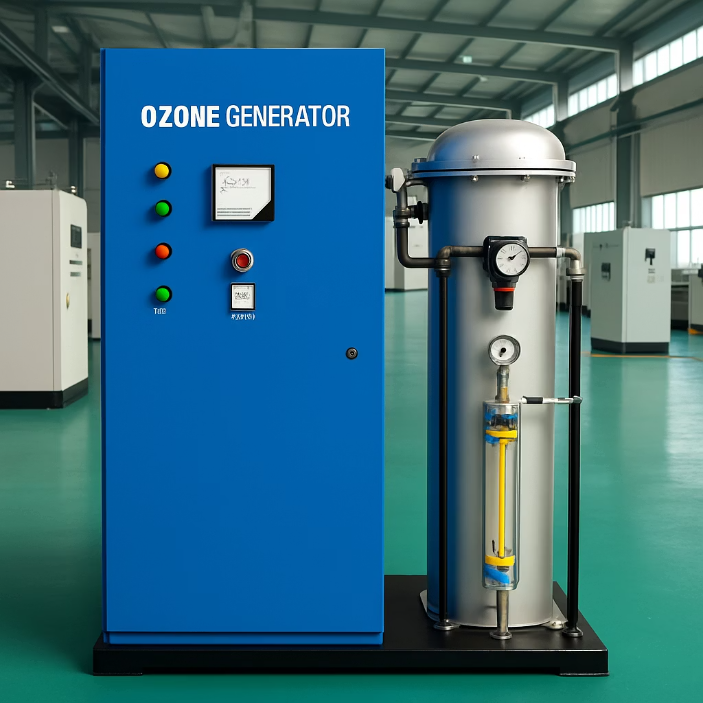
Mit Water supplies ozone generation and dosing systems for water and wastewater oxidation and disinfection. Ozone (O3) is one of the most powerful oxidising agents available for water treatment, with an oxidation potential of 2.07 V. It reacts rapidly with organic compounds, microorganisms, iron, manganese and colour-causing substances, decomposing back to oxygen without leaving persistent chemical residuals.
Working Principle
Ozone is generated on-site by passing dry, oxygen-rich feed gas through a corona discharge cell where a high-voltage electric field splits oxygen molecules into atomic oxygen that recombines to form ozone. The ozone-enriched gas is then injected into the water stream through venturi injectors or fine-bubble diffusers in a contact tank.
System Components
A complete ozone system includes an ozone generator, oxygen concentrator or liquid oxygen supply, ozone contact tank, venturi injection system, off-gas destruct unit, ambient ozone detector, and a PLC-based control panel. All wetted materials are ozone-resistant and the system is skid-mounted and factory-tested before delivery.
Ozone systems serve multiple roles across water and wastewater treatment:
- Drinking water disinfection and taste/odour control
- Bottled water and beverage production sanitisation
- Industrial wastewater COD and colour reduction
- Pharmaceutical ultrapure water system sanitisation
- Aquaculture and fish farming water treatment
- Swimming pool water treatment (reduced chlorine demand)
- Cooling tower biocide treatment
Technical Parameters
| Ozone Output | 5 to 5,000 g/h per generator |
| Ozone Concentration | 2 to 12 wt% (oxygen feed); 1 to 3 wt% (air feed) |
| Feed Gas | Compressed air or oxygen (PSA concentrator or liquid oxygen) |
| Cooling Method | Air-cooled or water-cooled |
| Contact Time | 4 to 15 minutes (application dependent) |
| Power Supply | 380V / 50Hz / 3-phase |
| Off-gas Treatment | Thermal or catalytic ozone destructor |
| Control System | PLC with HMI, ozone concentration and ambient monitoring |